CUVPOSA® IMPORTANT CONSUMER SAFETY INFORMATION
Read this Medication Guide before your child starts receiving CUVPOSA® and each time you get a refill as there may be new information. The risk information provided here is not comprehensive to learn more:
- Talk to your health care provider or pharmacist
- Visit www.cuvposa.com to obtain the FDA-approved product labeling
- Call 1-855-4MERZTX (1-855-463-7989)
Indication
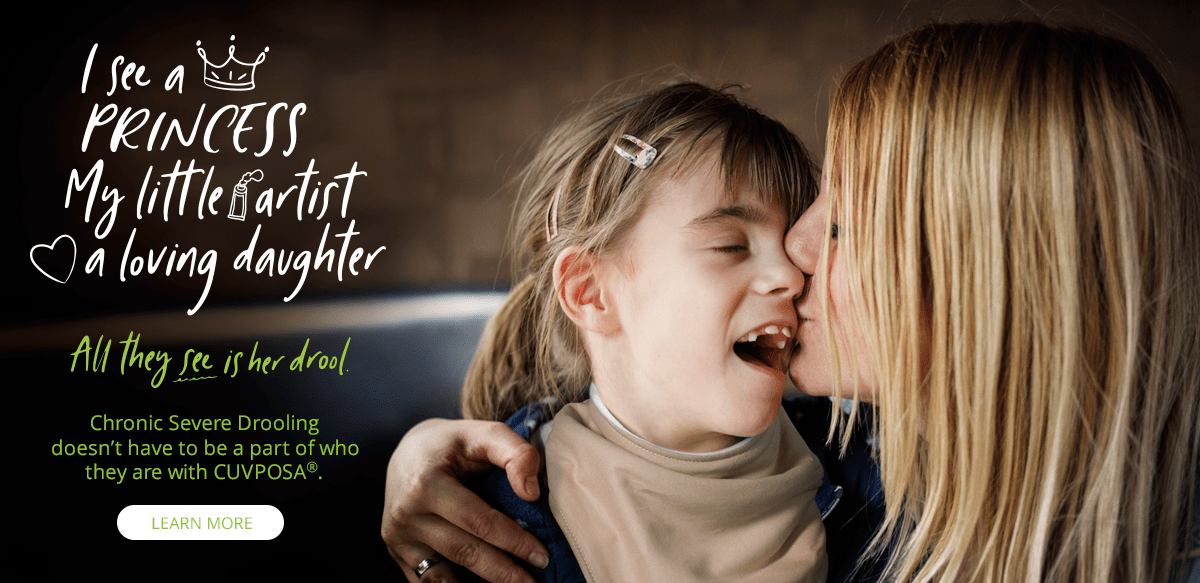
CUVPOSA is a prescription medication to help reduce chronic severe drooling in children aged 3 to 16 years with neurologic conditions that cause too much (abnormal) drooling.
Do not give CUVPOSA to anyone who:
- has problems urinating
- has a bowel problem called paralytic ileus
- lacks normal bowel tone or tension
- has severe ulcerative colitis or certain other serious bowel problems with severe ulcerative colitis
- has myasthenia gravis
Warnings
CUVPOSA can cause serious side effects including:
- Constipation. Constipation is common with CUVPOSA. Tell your doctor if your child strains with bowel movements, goes longer between bowel movements, cannot have a bowel movement, or if their stomach is firm and large. The dose of CUVPOSA may need to be decreased or stopped.
- Diarrhea and intestinal blockage. Diarrhea can be an early symptom of a blockage in the intestine. This is especially true if your child has a colostomy or ileostomy. Tell your doctor if your child has any diarrhea while taking CUVPOSA.
- Problems with control of body temperature (overheating or heatstroke). CUVPOSA can cause your child to sweat less. Your child can become overheated, and develop heat stroke if they are in an area that is very hot. Avoid overheating. Call your doctor right away if your child becomes sick and has any of these symptoms of heatstroke:
- hot, red skin
- decreased alertness or passing out (unconsciousness)
- fast, weak pulse
- fast, shallow breathing
- increased body temperature (fever)
The most common side effects of CUVPOSA include:
- dry mouth
- vomiting
- flushing of the face or skin
- nasal congestion
- headache
- swollen sinuses (sinusitis)
- upper respiratory tract infection
- problem urinating, difficulty starting urination
CUVPOSA may cause sleepiness or blurred vision. Do not drive a car, operate heavy machinery, or do other dangerous activities while taking CUVPOSA.
Tell your doctor if you have any side effect that bothers you or that does not go away. These are not all the possible side effects of CUVPOSA. For more information, talk to your doctor.
Call your doctor for medical advice about side effects. You may report side effects to FDA at 1-800-FDA-1088.
Tell your doctor if your child:
- has any allergies
- has any stomach or bowel problems, including ulcerative colitis
- has any problems with constipation
- has thyroid problems
- has high blood pressure
- has heart problems or abnormal heart beats
- has a hiatal hernia with gastroesophageal reflux disease (GERD)
- has any eye problems
- has any problems urinating
- has any other medical conditions
- is pregnant or plans to become pregnant. It is not known if CUVPOSA can harm an unborn baby.
- is breastfeeding or plans to breastfeed. It is not known if CUVPOSA passes into breast milk and if it can harm the baby.
Tell your doctor about all of the medicines that your child takes, including prescription and non-prescription medicines, vitamins, and herbal supplements. Some medicine may affect the way CUVPOSA works, and CUVPOSA may affect how some other medicines work.
Directions:
- Give CUVPOSA exactly as prescribed by your child’s doctor.
- Give CUVPOSA 1 hour before or 2 hours after meals.
- Your doctor will tell you how much (milliliters or mLs) of CUVPOSA to give your child.
- Do not change the dose of CUVPOSA unless your doctor tells you to.
- You must measure the dose of CUVPOSA before giving it to your child. Use a special marked dose measuring cup (available at most pharmacies) to measure the right dose of CUVPOSA.
- To help make sure that your child swallows the dose, you should use an oral syringe to give the child each dose of CUVPOSA, after you measure the dose needed with a dose measuring cup. Oral syringes are also available at most pharmacies.
- If you have questions about how to measure the dose or how to use an oral syringe, ask your pharmacist or doctor.
- The dose of CUVPOSA that is needed to control drooling may be different for each child. CUVPOSA is usually started at a low dose, and slowly increased as directed by your doctor. This slow increase in dose continues until the best dose for your child is reached, to control drooling.
- During this time it is important to stay in close contact with your child’s doctor, and tell the doctor about any side effects that your child has. See "Warnings".
Active Ingredient: Glycopyrrolate
Inactive Ingredient: citric acid, glycerin, natural and artificial cherry flavor, methylparaben, propylene glycol, propylparaben, saccharin sodium, sodium citrate, sorbital solution, and purified water.